Showing posts with label toman. Show all posts

Tuesday, April 19, 2011

The Giant Snakehead (Toman)

Giant Snakehead also called Toman In Malaysia and Indonesia


The Giant Snakehead, Channa micropeltes, is the largest in the family Channidae, growing to 130 cm in length and a weight up to 20kg (44 pounds). The Giant Snakehead is native to Thailand and it is widely distributed from India to Vietnam. In Malaysia and Indonesia they are called Toman, the common Thai name is Pla Shadow. Occurs in lowland river and swamp, usually associated with deep water bodies like the big hydro power reservoirs of South-East Asia. Also found in large streams and canals, with standing or slowly flowing water. Feeds mainly on fish but also takes some crustaceans and frogs. It spawns in small streams with dense vegetation. The Giant snakehead build a nest to lay their eggs in, and will attack anyone who comes too close.

The Giant Snakehead is a savage predator, and the Asian equivalent to a pike or a bass. They are aggressive fish that will take Surface lures, deep diving wobblers, spoons and even flies with ferocity! It will dive straight for the nearest snag or cover, their strong hard mouths and constant head shaking mean that these fish are the ultimate challenge for serious predator anglers. 

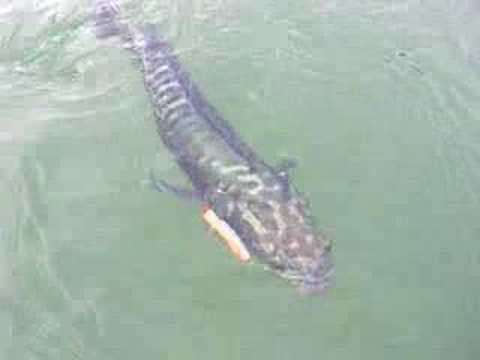
Giant snakehead cathing the bait

As long as a full-grown person and weighing as much as a 5-year-old child, the giant snakehead is not only the largest member of the snakehead gang, but also the most violent. In Southeast Asia, there are stories of this fish attacking people unprovoked, especially during the breeding season. Giant snakehead parents aggressively guard their spawn, which is unusual for a fish. The father corrals and guides the fry while the mother patrols at a distance, ready to voraciously attack anything that looks like a threat even something as large as a person.

there are about 30 species of snakehead

 There are around 30 different species of snakehead, ranging from the tropical Africa to the Far East and Russia. All are predators with streamlined bodies, sharp teeth and a reputation for extreme aggression. Snakeheads are also air-breathers. The fish will come to the surface, lift its head up, grab a mouthful of air and then submerge. The oxygen diffuses directly into a dense network of blood vessels encircling its swim bladder, an organ that doubles as a simple lung in snakeheads. This allows the fish to survive in stagnant areas where oxygen levels are low. It can even walk on land, using its soft pectorals to drag itself to new locations. It's said a snakehead can survive out of water for up to 4 days.

Snakehead Bait? Toman Bait?

Live baiting with Toman is also very popular. It has sharp teeth of the use of a short wireor heavy mono track is necessary to ensure that the system can not be severed. Bait ofwhole fish or strip can also be used. Other baits such as catfish and chicken intestineare frequently and successfully.
Snakehead catching the lures, make sure you have
many types of lures with various colour

colourful lures

catfish as the live baiting

P/S : make sure you use a wire leader approximately 5 inches
 to avoid breaking your leader.

Friday, March 4, 2011

Asian Snakehead Fish, the silent predator.


The Asian snakehead fish is actually not a single species; a lot of different species in the family Channidae are commonly referred to as Asian snakeheads. They are also known as Frankenfish and Channa fish. Snakeheads are not only native to South East Asia; many species have originated on the African continent. A few years back, the Asian snakehead fish received a lot of media attention since wild and breeding specimens were found in North American waters. The Asian snakehead is a very potent predator and if we allow it to become established outside its native region, e.g. on the North American continent, it could potentially disrupt the ecosystem. 

It is believed that the wild Asian snakehead fish that were found in the U.S. originated from fish markets and/or aquarists. Asian snakehead fish is a popular food fish in South East Asia and therefore also common in Asian food markets in the rest of the world. It can also be kept in aquariums, even though it requires a very large tank and plenty of food. To prevent Asian snakehead fish from being released into U.S. waters, importing live Asian snakehead fish to the U.S. is prohibited since 2003. 


Many aquarists objected to the nation wide ban, since Asian snakehead fish can not survive in the cooler parts of the country. An Asian snakehead fish released into a lake that becomes covered with ice during the winter will die, and many aquarists therefore feel that the Asian snakehead fish should be allowed as a pet in the northern parts of the country. An Asian snakehead fish needs to surface regularly to breath oxygen from the air and will die if prevented from doing this, e.g. by a layer of ice. The first wild and breeding Asian snakehead fish population found in the U.S. was living in the warm waters of Maryland. 

Before you decide to keep an Asian snakehead fish as a pet, you should always research that specific species in order to find out how large it can grow and how much it will cost to feed it. Many aquarists grow tired of their Asian snakehead fish when they realize that they must provide it with larger and larger aquariums, and feed it large amounts of expensive live food. It is not implausible that the wild Asian snakehead fish populations found in the U.S. were the result of someone spontaneously purchasing a few cool Asian snakehead fishes and then eventually releasing them into the wild. 


The biggest Asian snakehead fish species can reach a length of one yard (nearly one meter) and will need a very big aquarium to do well. All Asian snakehead fish species are predators and should be given meaty foods. They are fierce predators and watching them feed can be very entertaining. Do not be surprised if your Asian snakehead fish attacks a prey that is larger than half its own size. You can train your Asian snakehead fish onto dead food, and as soon as the fish understands that dead things can be tasty it will be very easy to feed. As a matter of fact, many specimens begin to investigate all dead things, including aquarium decoration, heaters etcetera.


Share |

Popular Posts